Guilin, Guangxi
(桂林市, Guìlín Shì, 广西; Guǎngxī)
3.8.2013
Another travel day ahead. Starting early morning, we headed towards Guilin, a place that keeps attracting people with its karst mountain landscape. From Anshun we first took a 90 kilometer bus ride to Guiyang, followed by an 8,5 hours train ride to Liuzhou. Travelling this part by train was a brilliant idea, because the scenery was heavenly, with mountains all around us all the way to Liuzhou. During all these travel hours I could hardly stop photographing the amazing views. Sadly though, the window of the train was very dirty, so I didn't get clear pictures.
As crazy as it may sound, we passed through a mountain between every five seconds to about three minutes! We must've passed through hundreds of mountains during the trip and only saw glimpses of sunshine now and then. At first, out of curiousity, I started counting the mountains we went through, but lost count somewhere over a hundred! This place was heaven for mountain lovers like us, and the train ride went fast because of the amazing scenery.
 |
| Mountain view from the train |
 |
| A city by the river |
We didn't reach our destination yet though, but had to take a bus from Liuzhou, which took two more hours to reach Guilin. At times the visibility was only two meters from the bus, because it was raining so hard. When we arrived to Guilin it was already past ten p.m. and dark, so we didn't get a proper layout and views of the city from the bus, but from what we saw, with all the hills everywhere, the place looked charming. We checked into our hostel This Old Place, which had a really warm welcome. The lady at the reception was also really nice to make us sandwiches and salads after the kitchen was already closed. Our room was really nice, but without a TV, which we didn't need though, because we usually spend most of our time outside the hotel. This Old Place is located close to the pedestrian street, rivers and many sights, that Guilin has to offer.
 |
| A monument in Guilin, with ancient seal script |
A FEW FACTS;
Guilin (present name since 1940, population; 4,747,963) is a prefecture-level city in the northeast of China's Guangxi Zhuang Autonomous Region. It is situated on the west bank of the Li River, which flows through the city, and borders Hunan to the north. Its name means "Forest of Sweet Osmanthus" and these sweet trees can be found in the city. In 1981 Guilin was listed by the State Council as one of the four cities where the protection of historical and cultural heritage, as well as natural scenery, should be treated as a priority project. The other three cities are Beijing, Hangzhou and Suzhou.
Ethnic groups of Guilin are Zhuang, Yao, Hui, Miao, Han and Dong.
Local industries are: condoms, pharmaceutical goods, tires, machinery, fertilizer, silk, perfume, wine, tea, cinnamon and herbal medicine.
Agricultural products are such as: Shatian pomelo, summer orange, Fructus Momordicae, ginkgo, moon persimmon, Lipu Taro, Sanhua alcohol, pepper sauce, fermented bean curd, Guilin rice noodle, water chestnut, grain, fish and dried bean milk cream in tight rolls.
 |
| Rongxi bridge |
Some of the sightseeing spots are Reed Flute and Seven Stars caves, Elephant Trunk Hill (象鼻山), Diecai Hill (叠彩山), Wave-Subduing Hill (伏波山), Yao Hill (尧山) and the mountains of Putuo, Lipu and Kitten, the latter being the highest peak of Guangxi. The Two Rivers and Four Lakes Scenic Spot refers to the landscape located around Guilin city, which includes part of Li River within the city, Taohua River, and the lakes of Mulong, Guihu, Ronghu and Shanhu.
Guilin also hides a city older than the Forbidden City in Beijing, the 14th century Jingjiang Princes' City. None of the sites main buildings are original though. The city was built for Zhu Shouqian, great nephew of Zhu Yuanzhang, who was the first emperor of the Ming Dynasty. Over two and a half centuries, the mansion was home to 14 Ming princes, later becoming the base of Sun Yat-sen, the revolutionary who shaped modern China by helping to overthrow the Qing Dynasty. The 216-meter-high Solitary Beauty Peak is next to the city.
 |
| Banyan twin bridges |
 |
| Beidou bridge at Ronghu lake |
4.8
We spent only two nights and one full day in Guilin city, so we had to be fast on sightseeing. Our day started by walking from Ronghu Lake to Shanhu Lake and finally reaching Li River. This route offered a lot of sightseeing, like Yingbin bridge, the ancient banyan twin bridges, pavilions, big banyan trees, the Glass Bridge, the Yang bridge underpass with beautiful reliefs, the ancient Southern Gate, Beidou Bridge, Mid-Lake Island and The Sun and Moon Pagodas. It was Sunday, so people had gathered to the parks for all kinds of pastimes. Some were dancing and playing instruments, and some were taking wedding photographs.
 |
| Yingbin bridge statue |
 |
| Wedding photograph session at Yingbin bridge |
 |
| Martial arts on the street |
 |
| Live music |
 |
| A monument in the park |
 |
| Sun and Moon pagodas |
 |
| Dancers in the park |
 |
| Feeling a bit small among these giants leaves |
 |
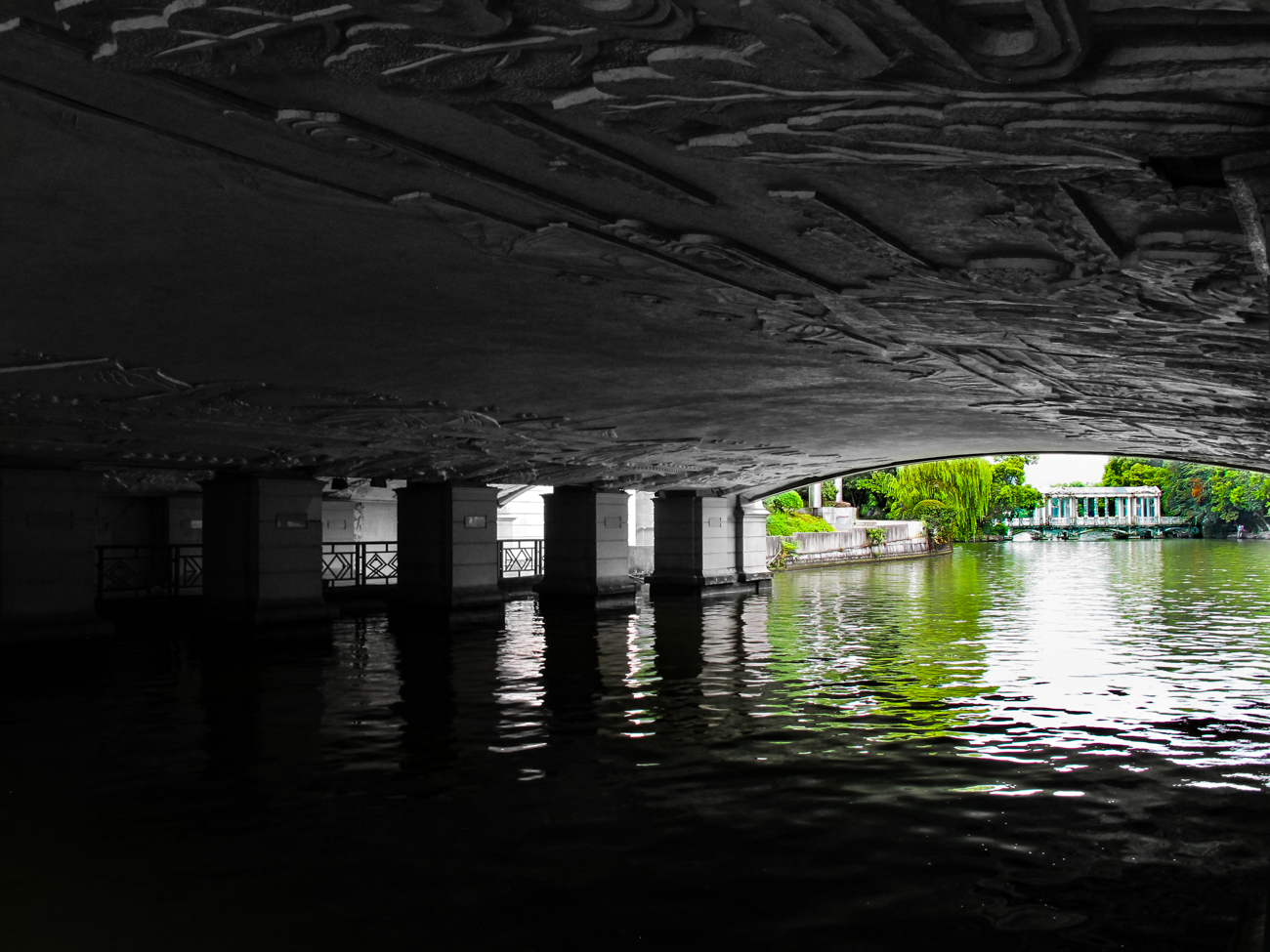
| Yang bridge underpass with beautiful reliefs. Glass Bridge is visible at the end. |
 |
| The reliefs tell the story of the changes and development of Guilin and the legends of its various historical celebrities |
When we reached the Li River we saw many people swimming in the shallow waters, while the cruise ships passed by. Walking along the river we headed over to see the Elephant Trunk Hill, but didn't bother to pay inside, it cost 70 yen to just see the hill, which we saw from further away. For a better view of the scenery with the elephant drinking water, you have to go to the other side and even take a boat. Some people were even swimming on the river to see the scene. We decided to continue to other sights, because we didn't have much time. You think you have all the time in the world when you travel for one year, but if you're like us, not much of a sunbather and love active lifestyle and sightseeing, you end up being busy.
 |
| People swimming on the shallow part of Li River |
 |
| Cruise ships passing by |
 |
| Li River, mountains and Jiefang bridge |
 |
| Jiefang bridge |
 |
| View from the bridge, with Elephant Trunk Hill mid left in the picture. |
 |
| Elephant Trunk Hill on right. |
 |
| Li River |
 |
| Statues by the river |
After crossing the Jiefang bridge - with even more beautiful mountain scenery in the background - we soon reached the Seven Star Park (七星景区, Qīxīng jǐngqū), an area of more than 120 hectares (297 acres), named because of the four peaks of Putuo Mountain and three of Crescent Mountain. Some of the parks main sights are Putuo Mountain, Seven Stars Cave, Guilin Zoo, Camel Hill, Crescent Mountain, Guihai Stele Forest and Light of China Square.
At an altitude of 265 meters, Putuo Mountain (where Avalokitesvara Bodhisattva is worshipped) is the parks main attraction with loads of caves and pavilions. Halfway up the mountain lies a two-storied pavilion Putuo Jingshe. Other sights are the Tomb of the Three Generals and the Tombs of 800 Heroes, Putuo Stone Forest, Xuanwu Pavilion, Zhaixing Pavilion and numerous valuable tablets. Two of the caves are Xuanfeng Cave and Seven Stars Cave, which is also called Qixia Cave or Bixu Cave. With a length of 1100m and over 120 inscriptions on its walls, Seven Stars Cave is one of the most famous attractions in Guilin. The cave got its name in Song Dynasty, but was already known since Sui and Tang dynasties. The caves lower floor has a subterranean river with tours by boats and the middle floor is also open for tourists. The widest point of the cave is 54 meters and the highest point is 27 meters. The whole journey is 814 meters, with the temperature at around 20 °C.
The first sight is Guilin's oldest bridge, the Flower Bridge, which dates from Emperor Jiaxi of Song Dynasty (1237-1240). It was renovated in 1965 and crosses the confluence of Xiaodong River and Lingjian Stream with 135m in length. The arches below the bridge are traditional Chinese architecture, reflecting full moons on the surface of the water. Chinese are artists when it comes to building beautiful bridges, but this bridge isn't, in my opinion, the citys most beautiful one. Every spring and summer flowers bloom around the bridge, hence the name.
 |
| Flower Bridge |
 |
| Flower Bridge as seen from Crescent Mountain |
 |
| Flower Bridge |
 |
| Crescent Mountain as seen from Flower Bridge |
A map of the Seven Star Park attractions is at the entrance of the park, but no information about the sights themselves is provided, so you have to know the details yourself. We had checked Guilin attractions beforehand what to see, but decided to make a simple walk through the park. What we saw were mostly artificial stuff like statues and monuments, pavilions and Camel Hill, where on July 1998 US President Bill Clinton made a speech about environmental protection. The hill lies behind Putuo mountain and is easy to recognize from its humps. Here is one of the Ten Scenes of Guilin. When the plum trees on the hill blossom in the spring, they create a glow together with the rays of sunshine. Bonsai gardens, the Guilin zoo and teahouses are also here.
 |
| Map of the Seven Star Park |
 |
| Justice theme at the park |
 |
| Justice theme continues |
 |
| Camel Hill is over 20 meters high |
You can even do rock climbing here and see pandas, tigers and elephants in the zoo. We rarely visit zoos, so we skipped it, even though they had our fave animal panda, but we already saw them in Chengdu. Read an earlier post about them
here. We instead enjoyed watching the wild monkeys with their babies, which were playing rough games and tumbling down the mountain. They didn't care for people and seemed to get food from the park workers. We could watch them peacefully and hope they won't hurt themselves while playing. It was so funny to see them swing from each others tails, etc.
 |
| Wild monkeys roam around in the park |
 |
| Stone carving mural at Light of China Square epitomizes the 5000-year Chinese civilization |
 |
| Light of China Square |
We enjoyed watching the city scenery from the Crescent Mountain, with all the various shaped Guilin mountains and hills spread across the city, making a magical, cinematic view. The stone steps lead you to Banyue Pavilion, Crescent Rock and Guanghan Pavilion, with beautiful sights of the city. You can enjoy vegetarian food here, which has a history of hundreds of years. Around the mountain also lies Guihai Stele Forest, which consists of Longyin Cave and Longyin Rock. The stele forest has more than 220 tablets, referring to politics, economy, culture and military affairs in forms of poems, posies, couplets and images. The characters in the tablets are inscribed in regular script, cursive script, seal characters and clerical script.
 |
| Guanghan pavilion area with a small luxury hotel |
 |
| View to the city from Crescent Mountain |
 |
| Amazing view of Guilin city mountain tops, with Li River (left bottom) |
After spending a couple of hours at the park we then took a bus near the Reed Flute cave (芦笛岩; pinyin: Lúdí Yán), which lies five kilometers from the city center. While trying to find the entrance to the cave we ended up circling the whole mountain area, because the Chinese maps are really vague and even Google was of no use. Finally, after a ninety minute walk and a few drink stops in the hot weather, we found the cave. With all the walking we've done during all our travels - we always end up walking the whole day and most travel days-, I think by now we must've walked already once around the earth.
 |
| Somewhere near the Reed Flute Cave |
Reed Flute Cave is millions of years old. The length of this water eroded cave is 240 meters. Inside you'll find various stalactites, stone pillars and rock formations created by carbonate deposition, but also about 70 inscriptions on the cave wall from the Tang Dynasty. During the World War II (1939-1945) and Sino-Japanese Wars (1894-1895, 1937-1945, Japan's invasions of China), local people used to hide here.
 |
| The huge pillars of Reed Flute cave |
 |
| The lights change at the cave |
 |
| A watery scene |
A tour of about one hour goes by too fast while watching and photographing the beautiful stalactite formations illuminating from the water.
 |
| Reflections at Reed Flute cave |
 |
| Reed Flute cave |
The cave - as all caves in China - has colored lighting to better bring out the formations, some of which have been named. Your imagination easily starts flying while watching around you, finding images on your own to be named. Being in a cave is like visiting another planet and all the caves are different.
 |
| Mid right; an alien with a dragon friend |
 |
| Reed Flute cave |
 |
| Curtains of Reed Flute cave |
 |
| A chameleon |
After the exit you arrive to a beautiful mountain scenery with fields. This area is much more peaceful than the city center.
In the evening we took another walk by the lakes, with colourful lighting everywhere. People were even now dancing at the parks and most seemed happy. Now the Sun and Moon Pagodas (also called Gold and Silver Pagodas) had lights, with the gold and silver lights shining and illuminating to the lake. The 41 meters high bronze Sun Pagoda has nine stories, whereas the colored glaze Moon Pagoda has seven. A 10-meter long glass tunnel links the pagodas under water, where a fish scenery surrounds you on the walk.
 |
| Sun and Moon Pagodas |
All the city sights had lights at night, including the bridges, trees and mountains. It was a surreal feeling walking in some areas under changing green, red, blue and then yellow lights. I liked the idea, but was also worried about light pollution to the nature. There aren't many places left anymore on earth, that we haven't spoiled with lights (and whatnot). If you've been on a night flight, you've seen how lit up earth is, it's crazy, and still beautiful.
 |
| Rongxi bridge at night |
 |
| Yingbin Bridge |
 |
| 800 years old big banyan tree |
We passed by The Southern Gate (古南门, Gǔnánmén) again too, which used to be the entrance to the city and is a remnant of the old walled city of Guilin. Now restored, the gate was originally constructed in the Tang Dynasty (618-907). You can walk the long tunnel hidden behind the gate to get an idea of what it was like to enter the city in ancient times.
 |
| Southern Gate |
 |
| Glass Bridge (玻璃桥,Bōlí qiáo) changes colours |
We had a relaxing walk in the park and felt a bit sad giving only one visit day to this picturesque city, but still we'd seen plenty and felt happy to have made it here. I recommend spending more time here and the whole of Guilin, which administers seventeen county-level divisions, including Xiufeng District (秀峰区), Xiangshan District (象山区), Diecai District (叠彩区) and Qixing District (七星区), which, while you're in Guilin city, you can easily visit. Guilin also includes rock climbers dream county, Yangshuo, where we were heading later, but first we took a little bamboo raft trip. Read about it in the next update.
 |
| Evening dancing at the park |