Social Icons

twitterfacebookgoogle pluslinkedinrss feedemail

Pages

Monday, July 10, 2017

Old Towns of Lijiang and Shuhe


July, 22, 2013.
Today we had to say goodbye to our friends who we met in Kunming a few days ago. We were continuing our journey by bus from Dali to Lijiang (丽江), which lies about 190 kilometers away. Our friends didn't want to travel to Lijiang, fearing what damage the rainy season has done along the way. It was at its worse now in China and Lijiang suffers most from it between July to August. Some mudslides had been reported in these areas, but since the bus was running we thought the bus company might know the roads are in driving condition.

The trip took a few hours and we arrived to Lijiang after sunset. Our hotel Pingshui Xiangfeng (萍水相逢) was nice with good service. The hotel is situated in the Shuhe Old Town, which is relatively unknown compared to the Old Town of Lijiang, thus being more rustic and tranquil with cheaper food and lodging and less crowded streets. Shuhe is also named Longquan Village (Dragon Spring Village, 龙泉村). It isn't the easiest place to travel from to the Old Town of Lijiang (busses pass irregularly), and Wikitravel advices to avoid this "more artificial area of Lijiang" and because you have to pay to get in (as you also have to in the other old town), but we never paid anything and enjoyed our stay here. Shuhe has similar old architecture to the Old Town of Lijiang and Naxi people. It was once famous for its developed leather working and education. Now it is a part of the Old Town of Lijiang.

Details of our hotel room. The keyboard is actually a coat rack.

View from our hotel room to the Old Town of Shuhe

Lijiang is an important transit point along the Ancient Tea Route. It was a center for the economic and cultural communication between various ethnic groups such as the Naxi, Han, Tibetans and Bai. Designated a UNESCO World Heritage Site in 1997, Lijiang's Naxi people still preserve much of their native Dongba culture and deep spiritual connection to nature. The city is nestled in a valley surrounded by mountains, and is a great place to escape stress; it has spectacular natural scenery varying from snowy mountains and highland glacial lakes to majestic canyons, making it a great place for outdoor activity lovers.

Some of the Lijiang sights include Jade Water Village, the Tibetan-Burmese Naxi people's Dongba village, Old Town of Lijiang (丽江古城), Baisha town and Tiger Leaping Gorge (虎跳峡, a great trekking area), Jade Dragon Snow Mountain (玉龙雪山, at 5,596 meters), Blue Moon Valley at the foot of Jade Dragon Snow Mountain, Black Dragon Pool (黑龙潭, Heilongtan) at the Yu Quan Park (Jade Spring Park), Lugu lake (泸沽湖, the Kingdom of women, at the Sichuan and Yunnan border, 6-8 hours drive from Lijiang) and Shuhe Ancient town.

July, 23.
JADE SPRING PARK AND ELEPHANT HILL

On the first full day we walked through the Shuhe old town to find a bus that leaves to the Lijiang city center, where you can easily reach most touristic places. On our way we met many Shuhe dogs, who kept guard at the local shops and hotels and were very friendly and well kept. They might be a way to lure in a tourist or are just pets, but these dogs offered a good way for navigating inside the town; if you memorized where each dog was you could find your way around the area that sometimes seemed like a maze. There were dogs of all sizes, but most were pure breds and larger than I've seen in any other countries. The dog in our hotel was a golden retriever.

Dogs we met

Instead of getting a bus (busses 6 & 11 go to Lijiang Old Town) we caught a taxi sooner and it only took about ten minutes to get to Lijiang. First we went to the Jade Spring Park, where the Black Dragon Pool is. At the time of our visit (2013) the pool was mostly dried up. It was filled again in 2014 and is now a water conservation area. We started our visit with a climb to the Elephant Hill (Xiang Shan, 象山). Before getting there we crossed a bridge and saw glimpses of the emerald coloured water that was left. The pool is home to many birds, fish and plants.

Before entering for the climb we had to sign ourselves in for the park ranger due to robberies or in case we got lost. Entering to climb the hill requires at least four persons in the group, so we climbed with two foreign Chinese students. Lijiang lies at an altitude of 2,400 meters (7,900 ft) and the top of the Elephant Hill is at around 2,650 meters, leaving not much to climb, but the climb wasn't as easy as we thought it would be. The path, mostly dirt with just few stairs, doesn't go straight to the top but wriggles and we climbed there with just tofu and juice for breakfast. There are two pavilions at the top, Songbe and Wanxue, and on the way up a small cemetary with the tombs of Yunnan historian Fang Guoyu and Fong Ziyun.

A tombstone at Elephant Hill

The first beautiful sceneries of the city can be seen after just ten minutes of climbing. Here you can see the Old Town of Lijiang and the park area. But the grand views are at the top and take about 40 minutes of climbing. Here you can see the Jade Dragon Snow Mountain, the city, artificial lake nearby and farm land. The wind is quite strong and it got cold soon, so we sat inside the pavilion for a while to take pictures. It took us over an hour and a half to do the roundtrip to the mountain and we spent another hour down at the park.

View from Elephant Hill to the Old Town of Lijiang (on far left) and
Jade Spring Park below

View from Elephant Hill to North to Qingxi Reservoir

Most of the buildings in the park can be seen along the way walking out of the park. There are many temples and pavilions from Ming and Qing dynasties: The Deyue Pavilion (Moon Embracing Pagoda, center of the lake, was originally built in the late Ming dynasty. The current structure is a reproduction from 1963 after a fire in 1950), Dragon God Temple (Longshen/Longwan Temple, constructed by local Naxi people in 1737) and the threefold overlap Five Phoenix Tower (Wufeng Tower, built in the Ming dynasty in 1601). The tower was moved to Jade Spring Park in 1979 from the Fuguo Temple 30 km away. The park also has Dongba Culture Research Institute and the Dongba Culture Museum.

There weren't many people in the park when we visited it so it was peaceful. The local tourists can get very noisy here. The park probably wasn't a big attraction at the time because the main pool was dry. Nowadays it looks very different than at the time of our visit.

We entered the park from North through this bridge.
This part of the pool was not dry.

Hanyue stage and Deyue Pavilion in the back

The Suocui Bridge is one of the main sights here. The Jade Dragon Snow Mountain reflects perfectly to the water below the bridge (now that there is water) and makes a great place for photography together with the pagoda. We had bad luck with both the dry pool and the mountain being behind the clouds, so we didn't get the perfect picture, but if you want you can have a local photoshop the mountain etc to your picture taken at the park. We didn't go for that.

Suocui white marble bridge and the dry Black Dragon Pool
(also called Heilongtan)

Deyue Pavilion and Suocui bridge, with little water on the other
side. The Jade Dragon Snow Mountain is hidden in the clouds.

An idyllic place for a break

Dry scenery at the park

Walking to the Old Town of Lijiang from here is easy. You follow a path that follows the Yushui river flowing from the pool and goes straight to the Old Town. It's not a long walk and after the park you follow just one street that comes to Yulong Bridge in the Old Town.

One of the bridges at the park near the Old Town

OLD TOWN OF LIJIANG (DAYAN)

A good landmark in the old town is the big waterwheel near Yulong Bridge at the North Gate. Around it you can find many restaurants with food (even McDonald's, KFC and Pizza Hut) and live music at Bar Street, which starts from the waterwheel, and it's easy to start sightseeing the area from here to many directions. The only way to get around is by walking, but the town is so small that you can cover it in a day. The old town stretches to Jin'an Street in the east, Xianghe Road in the south, Minzhu Road in the west and Elephant Hill in the north and is a similar maze of winding cobblestone streets to that of Shuhe town.

The impressive waterwheel at the Old Town North Gate

The town has an ancient water supply system with waterways and bridges. There are three canals and the layout of the town was established to conform to the flow of these streams in adherence to Feng Shui design, so there was water and waste disposal for the inhabitants. Some famous bridges were built in the Ming Dynasty (1368-1644), like Retaining Green Bridge, Big Stone Bridge, South Gate Bridge, Saddle Bridge and Longevity Bridge. All these details make the old town a unique place, which time seems to have forgotten. Due to its characteristics it is hailed as the Oriental Venice and Suzhou in Highland. It is also called Dayan Old Town and is the only old town without a city wall among all famous historical and cultural cities of China.

Welcome to the Oriental Venice

One of the canals

A beautiful scenery

Lijiang Old Town

The Old Town takes up an area of 3.8 square kilometers and was first built in late Song Dynasty (860-1279). It is located on Yunnan-Guizhou Plateau with an elevation of 2,400 meters. The town blends elements from several cultures. It differs from other ancient Chinese cities in architecture, history and the culture of its traditional residents the Naxi people. From 1523, when the Naxi chieftain was given the surname of Mu in the Yuan Dynasty, 22 generations of Mu chieftain ruled Lijiang for 470 years based on a hereditary system. The Mu Palace is at the foot of the Lion Hill and in its forest the Mu chieftains worshipped the sky, their ancestors and Mother Nature.

Naxi woman at her home door

A UNESCO World Heritage Site since 1997

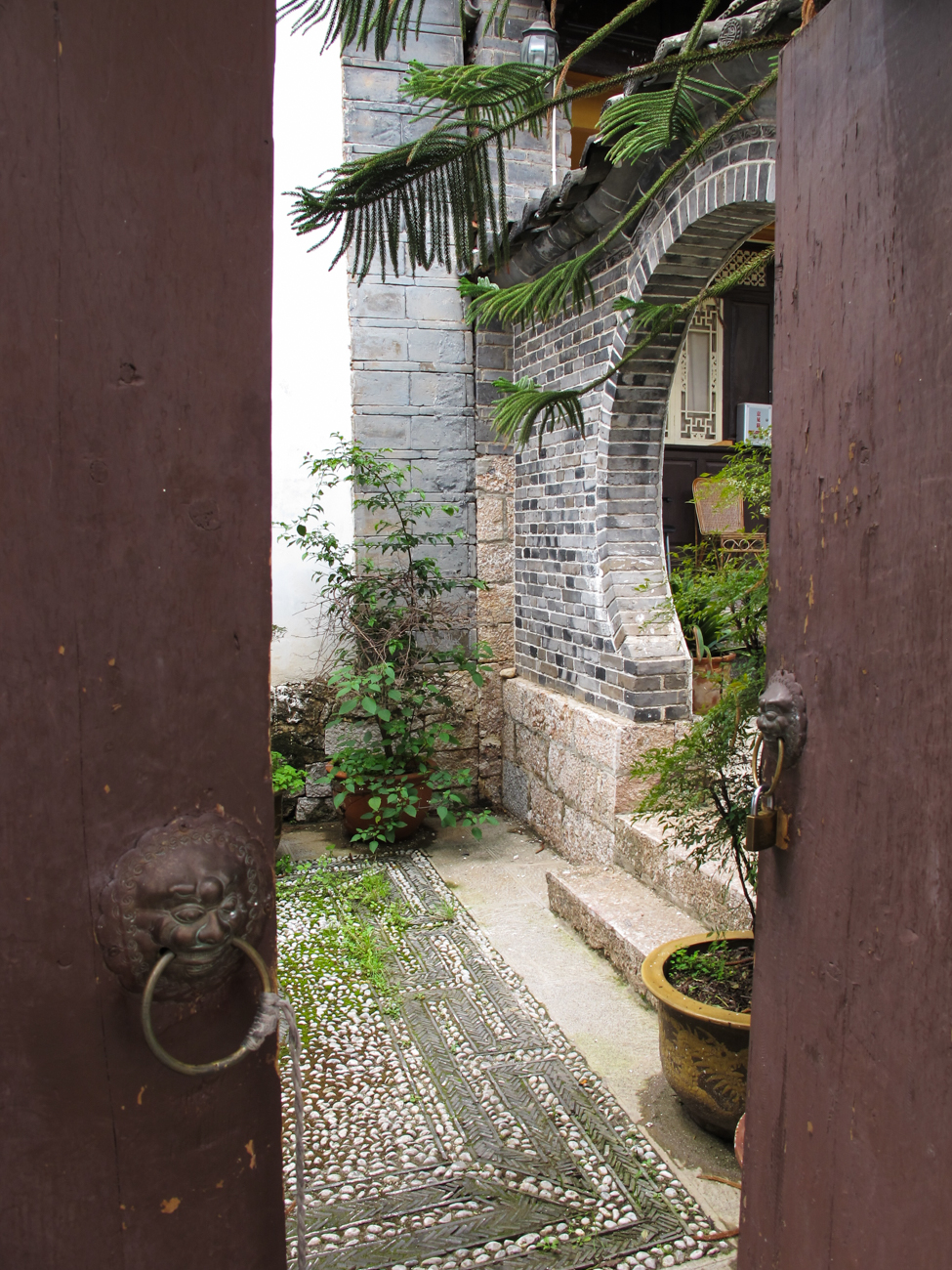
One of the beautiful courtyards in the Old Town

The town attracts young Chinese artists, students, and travelers. There are various shops for all tastes and you can watch locals at the streets make their own piece of art. Many of the tourist merch sold in China is the same as in Laos' Luang Prabang. I don't know who makes them, might be that the Chinese buy them from Laos or the other way around, but the colourful handmade clothes, bags etc are beautiful and not too expensive either. All the shops played the same tune over and over again and we couldn't figure out what it was and its importance, but it seemed to be local music and probably was Naxi classical music. The tune played in our heads still days after this visit.

Bar Street near North Gate with a lot of restaurants

Drying corn

One of the shops, mostly selling wooden handicrafts

Overlooking the old town is Lion Hill. The climb to the hill is not strenuous, but it is a hill and the cobblestones aren't the easiest to walk in. Here both the old and new city of Lijiang are visible and also the surrounding mountains and the entire Li River valley. At the summit lies the restored masterpiece of Qing Dynasty architecture, a 33 meters tall wooden Wangu Pavilion, which is covered by 10,000 dragon carvings. We only glimpsed it from afar, because it was either closed at the time or too crowded.

Wangu Pavilion

Building on Lion Hill

A mountain scenery from the Lion Hill

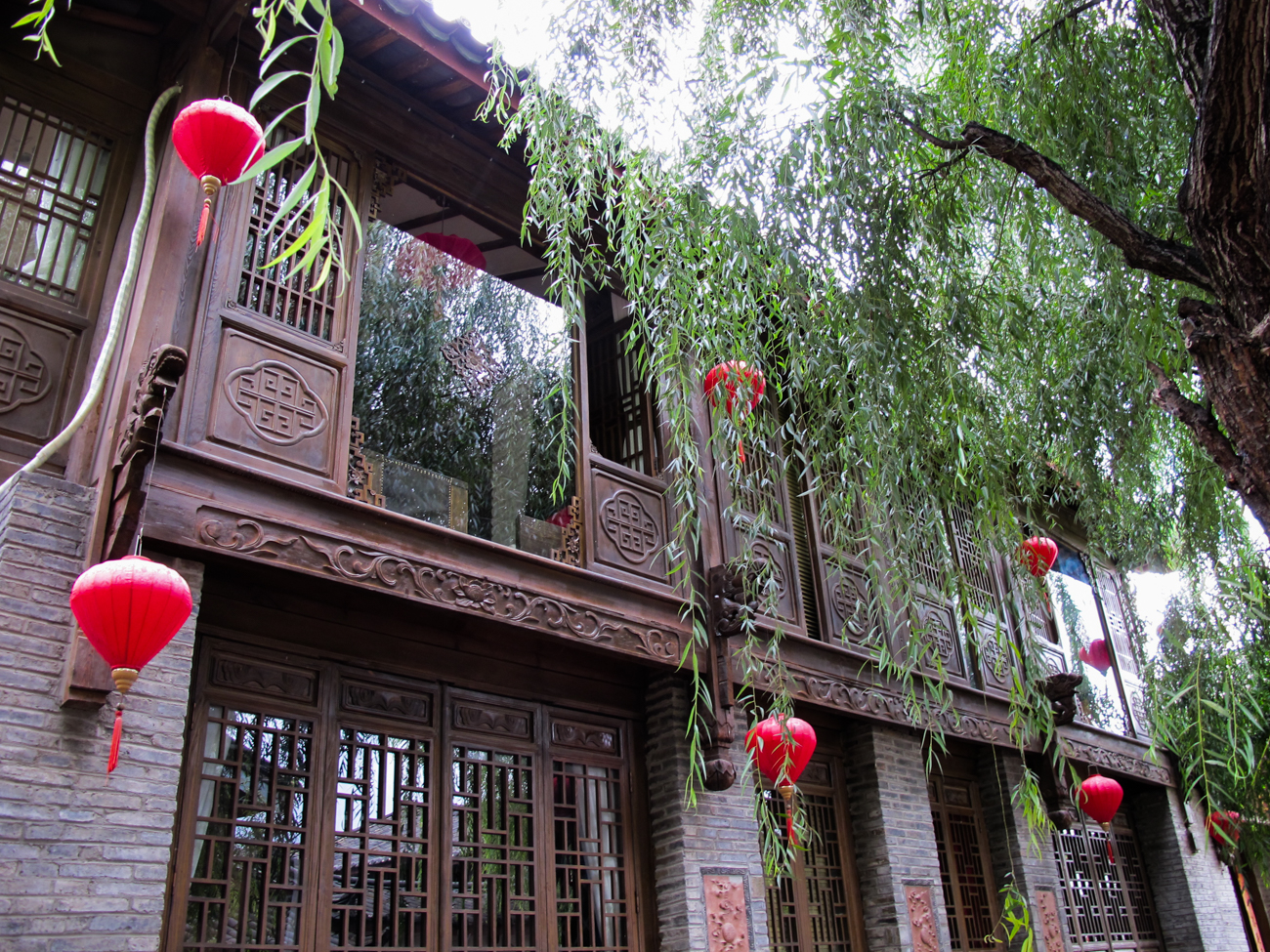
The many details in the Old Town together with willow trees and nature make the Old Town a charming place

We ended up walking a total of ten hours today. Mainly we were just wandering around and marveling at the Chinese history, architecture and nature, we didn't have any specific needs to see something. The last few hours we spent finding food, some supplies, an internet cafe and finding a bus or a taxi. Surprisingly the small supplies we bought were more expensive than in Finland. We couldn't find a vegetarian restaurant so we ended up eating tofu from the street again. As for the internet cafe, where we were supposed to print out our flight tickets for Chengdu the next evening, we found one but couldn't use the internet as we weren't Chinese citizens.

The last bus to Shuhe town didn't arrive. We waited for nearly an hour for it with locals, who were also wondering where the bus is at. Then we tried to get a taxi, but they didn't stop for us, so we ended up walking most of the six kilometers to Shuhe town, only catching a short ride from another bus, and walked the rest of the way to the hotel.

24.7.
This morning we had a lazy day in Shuhe town. As Shuhe is much smaller than the Old Town of Lijiang, it only took a while to check it out. You can even ride here in a horse carriage. The cobblestones and canals are present in Shuhe too and the town is very similar to the Old Town of Lijiang. Shuhe is a very important town in the Ancient Tea Route (Southern Silk Road) that leads to Tibet. The route started from Dali, Lijiang, Diqing, Lasa and led to India in the west. Shuhe is a famous cobbler town and is also known as the Village of Leather. The leather products are best sellers in Ancient Tea Route. Unfortunately fur is also sold here and some fur looked like it was from dogs. Because of trading activities along this road, the Naxi people gradually gave up the nomadic life, settled for farming and later started to do business.

Horse carriage at Shuhe Old Town

Fur products. Some of them look like they're from dogs.

Shuhe is called the Village of leather. Here is one
beautifully made costume from it.

Wood carvings

Two rivers run on each side of Shuhe and go through the whole village. The rivers, canals and roads make a dense web and link the town in a tight structure just like a honeycomb. Just like Lijiang Old Town, Shuhe is also a very picturesque little town, where time seems to stand still. The little canals that run through each house were dug this way so that each house would get water. When you walk on the streets you have to be careful not to fall into them, as no fences are around them. The town has many small bridges and boardwalks to walk at and they add more charm to the little town. Chinese are very skillful in making their environments attractive and serene. The houses here are more natural also than in the Old Town of Lijiang, as people use stones from the nearby mountains to build their house walls.

A canal on the street (on right)

Sifang square

One of the boardwalks at the Sifang square

Some of the sights include;
- Jiudinglong Pool (九鼎龙潭), from which the overflowing water winds through the village, has rainbow trouts. The fountain head of the pool is regarded as a holy spring by the local people.
- The Beiquan Temple (北泉寺, North Spring Temple) built near the pool is the same style as other temples in Lijiang.
- The Sansheng Temple (三圣宫, or Three Saints Temple) stands above the pool and is a traditional Chinese quadrangle.
- Longquan temple (holy palace) should also be somewhere near the pool.
- Qinglong Bridge (青龙桥, Green Dragon Bridge), built of stone pieces during the Ming Dynasty (1368-1644), measures about 25 meters long (27 yards), 4.5 meters wide (4.9 yards) and 4 meters high (13 feet). It was built by the Mu Family 400 years ago and is the oldest and largest stone arch bridge of Lijiang dam.
- Sifang street square is where the market is held during the daytime and here four paths lead to different directions. When we were here it was very busy, with a wide variety of foods on offer (except vegetarian) and handicrafts. You also find bars, restaurants and teahouses here.

One of the entrances to Shuhe Old Town

Shuhe architecture

Shuhe architecture

We only spent one full day and two nights at Lijiang, which wasn't enough for the sights the area has to offer. We missed out on so much, especially the hike at Jade Dragon Snow Mountain and Tiger Leaping Gorge, but these areas were closed at the time due to the weather. Because they were the main sights for us in Lijiang we decided to leave to Chengdu on a days notice. We also had to think of the days we still had left in China, we only had a month here. Chengdu was one important stop for us because of its pandas.

At five p.m. we got a ride to the Lijiang airport that lies thirty minutes from Shuhe. We had no paper confirmations about our flights, as we couldn't print them in the internet cafe or our hotel. We showed the confirmation from the laptop and that was it, nothing else was needed! The woman on the desk even spoke English, not too fluently, but still. Everything was strangely easy for us this time. Next we tried to find dinner, but somehow Western food for Chinese seems to be just pizza, burgers, French fries and baguettes. The only vegetarian food we found was French fries and fruit salad, so we had that. Meat burgers were everywhere. For breakfast we ate one dry rye bread and juice. That was our food for the whole day. It has not been easy to find vegetarian and decent food in China, especially when you don't speak the language.

Lijiang specialty sold here, dried yak meat.

Various snacks

Our one hour flight left at eight p.m. to Chengdu. We had a strange but kinda funny incident at the plane at take-off. As you can expect anything from the Chinese, this time one Chinese passenger was messing with his bags when the plane was already waiting to take off. The flight attendant got his bags sorted out only after the plane had already started gaining speed and he had to run fast to his chair to reach it before it was too late to walk or run anymore! We've never seen anything like this. The flight attendant was just seconds away from being bounced around at the aisle from "g-forces"!
We had a huge thunderstorm on the way with beautiful lightnings above the clouds. I even saw horizontal lightnings, which lit all the clouds in the area. It was amazing! I would've wanted to stay there and watch the whole thunderstorm through.

Lijiang airport at eight p.m.

A dragon shaped cloud said goodbye to us

More info on Lijiang: Chinaculture.org

Next blog: Chengdu and pandas!

Wednesday, March 1, 2017

From flooding Kunming to Dali


July 19, 2013.
Kunming city flooded last night. The Panlong river, which receives large quantities of municipal sewage and wastewater from industries and runs through Kunming, flooded all over due to heavy rain. It rained one meter in a short time. Since we travelled in China during a rainy season there had been some mudslides, but we had been lucky so far with the weathers. And today we were leaving Kunming, only experiencing a small amount from the horror what these rains can bring with them. People were panicking and running fast all over - even driving on the walkways like it was the end of the world! Those who risked driving their motorbikes in the city sank halfway to the pools. The police managed the traffic and some flood barriers were built. An open roof shopping mall was flooding inside too and what roof the building had was falling apart. I wonder why they build open roofs here.

Flooding Kunming

Flooding Kunming

Flooding Kunming

Before leaving Kunming we went to the city to get some medicine, to eat and buy some stuff for the train trip. We had to use the translator app again to get the meds, because the pharmasists didn't understand the meds name in English. Luckily the app knew the name in Chinese! We tried to do some shopping at the Old City Street market, but some shops weren't open at early morning hours. Some of the pet sellers were there with cats and guinea pigs which weren't doing too well. This pet market was far worse than the one we saw before. They even sold little pigs and pigeons, and beetles in large baskets in thousands. What a sight! I saw the cutest husky puppy on another street where the police had stopped the handler. Maybe she was doing something illegal.

We managed to walk in the city without wetting our shoes too much. Our new friends weren't so lucky. They told us later that the water reached waist up where their hotel was located! That area had flooded badly! When we headed back to our hotel we couldn't catch the bus from the streets we were in. We had to walk half an hour to where one stopped! Our hotel street was flooding in the morning too, but now there was only a little puddle left. We had to say goodbye to the "fancy" Las Vegas style hotel, which actually has its own performing stage and balcony seats too. But it wasn't a sad goodbye, we weren't going to miss the pool with green algae and trash in it and the other quirky things about it. We had slept well there though, even when the local tourists were yelling every night and keeping their room doors open for fresh air from smoking. Our room felt like a smokehouse though, because of their smoke.

In the evening a young taxi driver picked us up from the street on our way to the railway station. We had waited quite a while on the street again for a taxi to pick us up and now this young man stopped and even greeted us in English with a cheerful smile and helped us with the luggage. Again a young Chinese was being friendly towards tourists. While waiting at the station for our friends to arrive we listened to some communist music played loudly through the station speakers. It felt like I was back in the eighties Soviet Union, which was at the time very different from todays Russia. I had my first travel experience of communism when I travelled to the Soviet Union twice in the eighties. I have good and bad memories about those trips and China has also given both.

Before entering the train boarding area they checked our passports and tickets. After boarding the tickets were changed into plastic ones, which you returned upon arrival. We didn't have to wait long to enter the train. We had hard sleeper beds in mid level with a blanket, pillow and another blanket as a mattress. It was good enough to sleep in. The room had six beds and no door and felt a bit unsafe, so we couldn't sleep at all. Our beds felt a bit safer though than the floor level beds. We put our smaller bags behind our pillows, but because there was no room for bigger bags they were put in the corridor shelve. The lights were put out when the train left the station, only the corridor light was on. It's good to have your own torch if you want to read in the train. The toilet was just a hole on the floor without paper and wet all over. The trip to Dali took six and half hours, with a few stops along the way.

Train aisle

July, 20.
The lights were put on thirty minutes before we reached Dali in the early morning hours. We arrived at 4:30 am, so the taxis had higher rates. Our Chinese friend Jen haggled for a while with the drivers and made a good deal, there were seven of us now with a French family of three. The taxi drivers didn't like to lower the price, but because they had to deal with another tough Chinese haggler the price was better than what other tourists would get.

We hadn't booked a hotel beforehand, so we followed the French family to their place. Everything was closed at this hour. The French got into their hotel, but didn't get rooms immediately. We had to find another place and our taxi driver had an idea, so we went there. There was only a night guard, so we had to wait nearly three hours for someone to show up, and we weren't even sure if we get a room. While waiting there Jen and Kari went to check other hotels nearby for available rooms. One hotel we looked at through Agoda said they have three rooms available, but turned out they didn't. Agoda is not accurate with updates sometimes. But we got rooms around eight am from the hotel where we were waiting at. This was the first hotel in China on this trip with a hole as a toilet. The open system is not clean, it stinks and you easily wet your feet if you're not careful. I'm no fan of this system. No wonder most of the Chinese toilets stink a lot, with pee everywhere. Better hotels usually have toilet seats. We stayed in this hotel for one night.

Our first hotel in Dali

Although we didn't sleep at the train we decided to check out the Old Town (古城), also called Ancient City, with our tired eyes. Some other Dali sights include the Erhai Lake (洱海), Cangshan mountain (苍山) , Three Pagodas of Chongsheng temple, Plateau Pear, Jizu Mountain, Jinsuo Island, Tianlong Babu city, caves and everything in the Old Town, which according to literature was a gateway to the Silk Road in Southwest China. The Old Town has, for instance, old traditional Bai ethnic minority folk houses, a Christian and Catholic church, a museum, temples and the city gates, where you can walk part of the wall that surrounds the city. The length of the whole wall (only part of it accessible) is 6 kilometers (3.73 miles) with a height of 7.5 meters (24.6 feet) and thickness of 6 meters (19.7 feet). There are five (or six, depending how you count them) city gates with a gate tower facing west, east, north and south. The city layout was uniform; five main streets from south to north and eight main streets from east to west. The marketplaces have remained unchanged. Tourists usually come to the Old Town and see the nearby places. The 1500-meter Fuxing Road is the main street and the busiest street in Old Town, linking South Gate and North Gate. Other main streets are Foreigner Street (洋人街) and Renmin Road, which is 1,2 kilometers long and leads to Erhai Gate.

Dali (大理) is a county-level city in Dali Bai Autonomous Prefecture in Yunnan, which has both the modern industrial city (locally called Xiaguan) and the Ancient City, which lies thirteen kilometres away. The development in machinery, electricity, textile, chemicals, papermaking, tea processing, marble products, etc has turned Dali into an industrial base in the west of Yunnan. The mainstays in the economy of the city are the production of cigarettes, tea, marble articles, clothing, cement and electric power. The Dali marble, Tuocha (white tea), furniture, tie-dyed cloth, straw woven hats and plywood are well known around the world. Dali also produces rice, wheat, broadbeans, maize, etc. The climate is pleasant and spring season prevails all year round.

In 2003 Dali's Three Parallel Rivers National Park became a UNESCO World Heritage site. Descending from Tibet, these three rivers run parallel to each other for over 200 kilometers. The rivers are China's greatest river Yangtze, Southeast Asia's Mekong and Myanmar's second river Salween. The rivers have different names in Dali though. Salween is Nu Jiang (怒江), the Mekong is Lan Cang Jiang (澜沧江), and the Yangtze is Jin Sha Jiang (金沙江). If you want to explore the National Parks in China, the tickets are usually more expensive than in other countries, running somewhere between 20-45 euros.

The Old Town is about twenty minutes drive from the railway station. There were zillions of tourists already in the morning. The Old Town is a big area, where we walked a couple of hours. It can be done in a day, but preferably take at least two days. Dali area itself has plenty to see and if we would've had more time in China we would've stayed here more than two days. Dali lies close to Myanmar, if you want to travel there next.

Many of the Old Town buildings have tourist shops inside

Shops at South Gate

Sweet natural snacks

Cute shop

Entrance to Dali Municipal Museum, formerly known as Marshall Mansion. The museum was home to Du Wenxiu (1828-1872), the Chinese Muslim leader of the Panthay Rebellion, an anti-Qing revolt in China during the Qing dynasty.

Wuhua tower, first built in the year of 856.

Dali has an interesting history, as most places in China do. I won't go into that any deeper, but here's something; Kublai Khan was attracted by the Wuhua tower (picture above) when he captured Dali. The building was destroyed during the war of early Ming Dynasty and built again in 1999. The Old Town was the ancient capital of Nanzhao Kingdom and Dali Kingdom. The Mongols destroyed this old capital and brutally displaced many of the inhabitants of the prefecture. The Old Town today is the rebuilt Ming town and it is mostly built from stone and marble from the Cangshan mountain, which makes it unique and different compared to, for instance, the wooden buildings of Lijiang Old Town.

The Old Town with marble everywhere

Mystery building

The People's Hero Monument

South Gate. Here you can walk the wall and see the surrounding scenery.

South Gate building

Walking the wall; forgotten part of the wall

View from the wall; the Old Town, Wuhua Tower and
Cangshan Mountain in the back.

The beautiful paintings on local houses

The wall and Mt. Cangshan

Local house with a restaurant

Lake Erhai and the city

The wall and Lake Erhai in the back

Lake Erhai is an area of about 250 square kilometers (97 square miles). In size, the North-South length of the lake is 40 kilometres (25 mi) and the East-West width is roughly 7–8 kilometres (4.3–5.0 mi) and its average depth is of 11 metres (36 ft). The lake is situated at 1,972 metres (6,470 ft) above sea level. You can visit the islands on the lake, which include Guanyin Ge, Jinsuo Island (金梭岛), Nanzhao Folklore Island (南诏风情岛) and Xiaoputuo. If you want to swim in the lake beware, the schistosomiasis (bilharzia) parasite has sometimes been found there.

The Foreigner Street, or Huoguo Road, has lots of shops, cafes, restaurants and bars for tourists and it is said to be the place for Western tourists. We had the idea that it would be the easiest place to find vegetarian food, but it was hard. The street didn't seem too focused on foreigners, although the area used to be a backpackers heaven. Most of the menus were in Chinese and they didn't serve any vegetarian food. On top of that only one place spoke English, so we decided to eat there and had spaghetti. Many of the restaurants also seemed unappealing for most part.

It turned out that nowadays the street attracts more Chinese tourists than Western. The Old Town has restaurants all over, so you might find a restaurant more suitable for you outside the Foreigner street. The name of the street actually comes from the uprising of local people opposing Yuan Shikai to be the emperor of China. The street was decided to be the center for tourism later in the 1980's. In the evening it looks more appealing under the stars, with coloured lights lining both sides of the street and the sounds from the water streams relaxing the mind.

The Foreigner street looks nicer in the evening with more seats set up and lights

The Foreigner street culvert channelling mountain water
through the Old Town to Erhai Lake

Doesn't look appetizing

Walking in the Old Town can sometimes be a bit challenging for a Western tourist. Here, as in many places in China, you're constantly being asked for photographs and photographed anyway. Some of the people don't even ask you in a photo, instead they treat you like an object; they just grab you by the hand standing next to them in the photo before you even realize what has happened. Some locals might even come to you and touch your hair without asking. A foreign tourist is still a peculiar thing in China.

Characters probably from a Chinese TV-series

Mid-day exercise

Local guide, wearing traditional Bai peoples clothes

Entrance to the Wu Temple and its three courtyards

Second entrance to the Wu Temple. There are three gates before the temple.

The main hall of the Wu Temple was built over 600 years ago, but was destroyed. They managed to reconstruct it though.

Wu temple details

Wu temple courtyard

The beautiful alleys of Old Town

The mountain water running through the Old Town to Erhai Lake

Palace hotel

The Christian church was built in 1904

North Gate

Since we had the idea to change hotels for the second night we decided to check the Five Elements Hostel in the daytime, when you could still see the surroundings well. And because there seemed to be a lot of tourists around it was better to check in to a hotel early to get a room. Five Elements Hostel has a friendly atmosphere, the workers speak English and they have rooms for all needs. We decided to get a proper room, no dorm, with our own bathroom and a toilet that wasn't a hole on the ground. Everything was clean, the room was warm and there was plenty of things to do like play games, read books, watch TV, play with the house pets and make new friends, if you had the time. The hostel has their own restaurant and internet too.

We changed hotels. Five Elements hostel was very nice.

Five Elements hostel just outside The Old Town

Five Elements hostel keeps house pets

The Cangshan mountain (or Cang-mountain, Shān means mountain), with its 19 peaks lining up from north to south, looks very fascinating from the Old Town. The mountain has an average altitude of 3,500 meters (11,483 feet) with the tops perpetually covered in snow. The highest summit, Malong, is 4,122 m. There are many trekking opportunities, for example Jade Belt Road (also called the Cloud Road) and sights to see such as temples, pavillions, ponds, waterfalls, lakes and the area is rich and diverse with flora. We didn't have time to go trekking, but after seing the Old Town we decided to take a guided tour to see at least something outside the walls and around the Dali area during our short visit. Jen organized everything for our group, so we didn't have to struggle with Chinese again. We were thinking of going to see the cormorant fishing, some caves in the mountain and the nearby pagodas.

The cormorant fishing has a tradition of 1,300 years. The fishermen use trained cormorants, which catch fish for them. This method has also been used (and is still used in some countries) for example in Peru, Japan, Greece and Macedonia. The fishing turned out to be a bit too expensive and it was only for a show, so we passed that one. Besides, we knew we could see that also elsewhere in China, and it started to rain, so we didn't want to sit in a boat without raincoats. Instead we headed to the Cangshan mountain next to see the Tianlong cave (天龙洞) and temple near the Shangguan town at the other end of the Erhai lake at Yunnong Peak.

Taking the Tianlong cableway to the cave

Scenes from the Chinese TV-series Tian Long Ba Bu were filmed here. The series is based on the novel Demi-Gods and Semi-Devils by Jin Yong (Louis Cha).

Chinese use colourful lights in caves to make them look more
fascinating. Works for me.

Something mysterious going on

The cave is 8 million years old

Locks outside

View from Cangshan mountain to Erhai lake

From the cave we headed to the Three Pagodas of Chongsheng Temple/Monastery, but only outside, since we've seen plenty of temples already. The original Chongsheng Temple (constructed after the completion of the three pagodas) was burnt down during the Qing Dynasty and rebuilt in 2005. The pagodas, which are made of brick and covered with white mud, are resilient, they have endured several man-made and natural catastrophes over more than 1,000 years. Qianxun Pagoda in the middle is one of the highest pagodas in China's history (reportedly built during 823-840 AD, Tang Dynasty). It is 69.6 meters (227 feet) high and over 1,100 years old! The other two sibling pagodas were built about one hundred years later. The temple area has a beautiful garden too, so check it out if you visit here and have the time and interest. Nowadays you can't climb to the pagodas, but you get nice views of the city by going to the mountain.

The majestic Three Pagodas lie only one kilometer away from the Old Town.

Outside the Chongsheng Temple area. We didn't go in.

The Phoenix statue close to the Pagodas

View to the lake from the Pagodas

Yunnan Province lies in an area of low latitude and high altitude, with a quite diversified climate around. The province has the greatest number of minority groups. Apart from the Han people there are 25 other nationalities, which constitute almost one-third of the total population. Yunnan's unique geography, special climate and colorful human geography all make its culture and customs very different from any other place in China. The various oddities of Yunnan have often been listed as Eighteen wonders of Yunnan (the oddities vary):

1. Eggs are sold in straw bundle
2. Rice is sold in cake form
3. Three mosquitos are sold as dish
4. Stones touch the sky
5. Straw-hats may be used as pot covers
6. The dressing does not tell the season
7. Good farmers are always old women
8. Bamboos are used as tobacco pipes
9. Foals here are invariably powerful
10. Grasshoppers are dishes to go with wine
11. Fresh vegetables are available all year round
12. Quality tobaccos are consumed but sold to nowhere
13. Wild green foods are sold well home and abroad
14. The train here does not run as fast as the car
15. Baby-sitting is a man's job
16. Wherever there is a cave there is a tourist destination
17. Crossing-the-bridge rice noodle is a famous local specialty
18. Flowers are blooming all four seasons

For more help travelling in China, visit China's largest online travel agency (English version), Ctrip.

Next blog: Lijiang, China.


Briefly

Escaping the madness of the Western world, a couple that has travelled most continents takes a year off to search a new direction to their lives, the next destination staying open

Translate